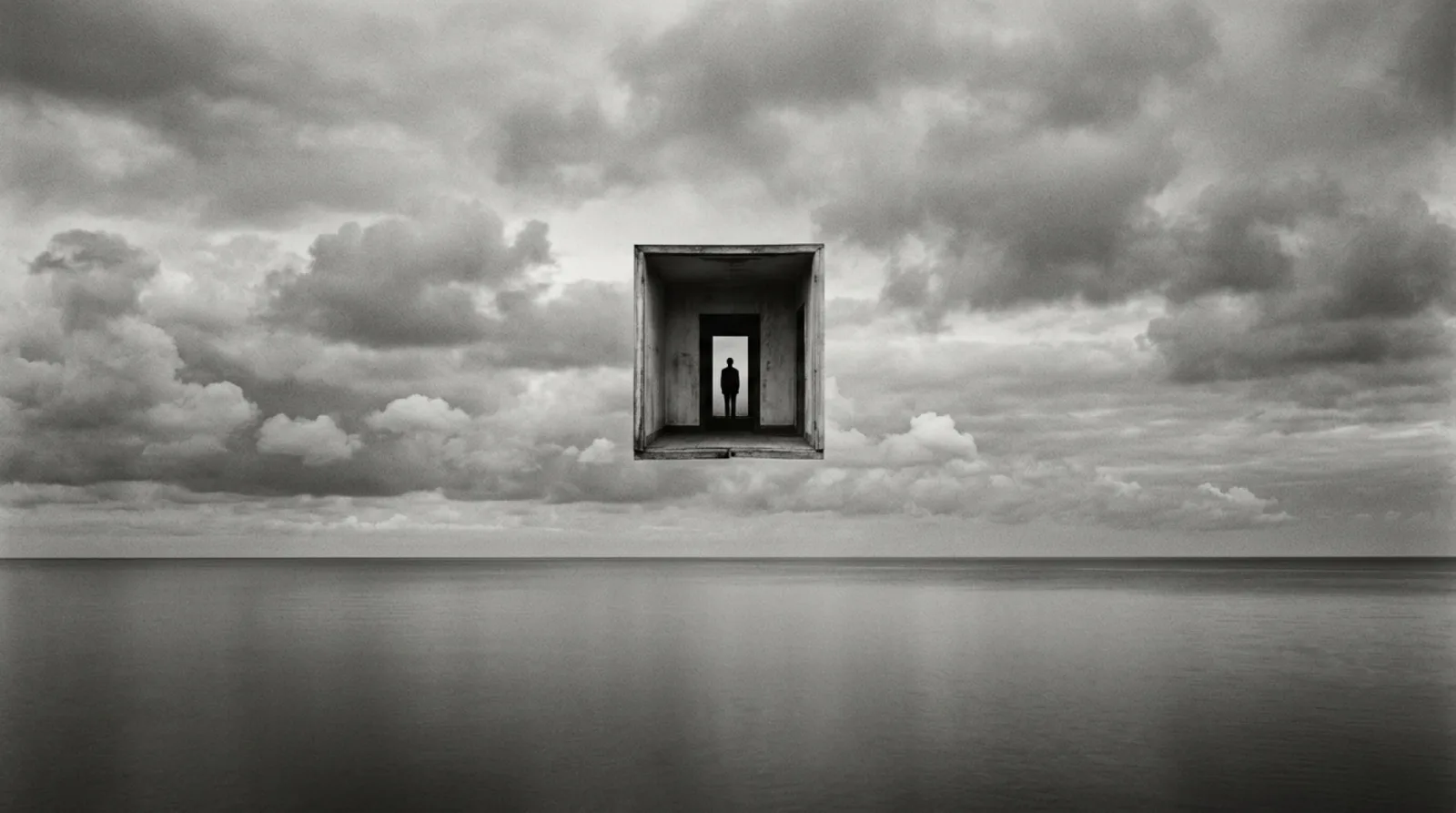
The Coen Brothers have made many different kinds of films. They have made screwball comedies and folk-music elegies and Western revisionism and suburban farce. But running through virtually all of it is a consistent preoccupation with a particular type of human being: the person who cannot act, or who acts and finds that action changes nothing, or who acts and is destroyed by the consequences without ever understanding why.
This is not the existentialism of Sartre's famous formulation, that existence precedes essence and that human beings are therefore radically free. The Coen Brothers are interested in a bleaker variant: the person who possesses freedom in theory and finds it meaningless in practice. Their characters tend to be not tragically constrained by external forces but tragically unable to exercise the volition that, in theory, is available to them.
The Passive Protagonist as Recurring Form
Before discussing Ed Crane specifically, it helps to map the broader pattern. Jerry Lundegaard in Fargo is a schemer whose plan immediately collapses into chaos he is powerless to contain. He is not a stupid man. He is a frightened one, and his fear paralyzes him precisely when decisive action might save him. Barton Fink, the playwright sent to Hollywood, is consumed by a creative block that renders his artistic ambitions entirely nominal. Larry Gopnik in A Serious Man moves through a series of catastrophes that arrive without cause and depart without resolution, consulting religious authorities who offer him riddles and anecdotes in place of answers.
What these characters share is a relationship to their own lives that is fundamentally spectatorial. They watch things happen to them. When they do act, their actions tend to originate in panic or misapprehension rather than in genuine deliberation. And the universe meets their efforts with indifference, or with something worse: a response that is not punishment, exactly, but consequence without proportion.
Ed Crane: The Purest Case
Ed Crane, the barber at the center of The Man Who Wasn't There, is the Coen Brothers' most concentrated examination of this type. He is introduced through his own voiceover, a narrative device that in conventional noir signals access to the protagonist's inner life. What Ed Crane's voiceover provides instead is a kind of meticulous, affectless description. He describes what he sees and what he does. He rarely describes what he feels, and when he does, the feeling is almost immediately qualified into uncertainty: he is not sure what he wanted, not sure why he did what he did, not sure what anything means.
This is not the laconic stoicism of the classic hardboiled protagonist. Sam Spade and Philip Marlowe, whose terse surfaces conceal principles they are prepared to die for. Ed Crane's silence is not a mask over convictions. It is the thing itself. There may be nothing underneath. He says this himself, at one point, with no particular distress: he is the barber, the man who cuts other men's hair and says nothing, and he has come to understand that he does not know how to be anything else.
Fate, Causality, and the Noir Universe
The existentialist reading of The Man Who Wasn't There is complicated by the film's explicit engagement with Heisenberg's uncertainty principle, which Ed Crane encounters through a book and seizes on as a framework for understanding his situation. The more precisely you observe something, the less you can know about it. Ed applies this to himself: the more he tries to understand his own situation, the more opaque it becomes.
This is a somewhat eccentric reading of quantum mechanics, but it serves a genuine philosophical purpose. The Coens use it to position Ed's passivity not as a personal failing but as a response to a world in which knowledge and action are structurally disconnected. You cannot act well because you cannot know enough to act well, and the attempt to know more simply generates more uncertainty. The rational response, in this framework, is to do very little, which is, of course, exactly what Ed has always done.
The noir genre has always been interested in fate: the sense that the protagonist is moving through a world that has already determined his destination, that free will is an illusion and the detective's investigation merely traces a path that was laid out before he began. The Man Who Wasn't There takes that fatalism and gives it a philosophical vocabulary. It is not just that Ed cannot escape. It is that the concept of escape requires an agent capable of choosing, and Ed Crane is not quite sure he is that.
Comparison with the Wider Canon
The film sits in interesting relation to No Country for Old Men (2007), which is the Coens' other sustained engagement with questions of fate and meaninglessness. Where Ed Crane is passive and internal, Sheriff Bell is active and garrulous. He talks throughout the film, about dreams and his father and what the world has become. But his talk is another form of helplessness. He cannot stop Anton Chigurh. He cannot understand a violence that operates outside any moral framework he possesses. He retires. He dreams.
Both films suggest that the specifically American mythology of individual agency is a fantasy that the universe does not share. Ed Crane's version of this is quiet and without bitterness. Bell's version carries genuine mourning. But they arrive at similar territory: the recognition that the self is smaller than it imagines, and the world is less interested in human meaning than the stories we tell about it suggest.
The Comedy Dimension
It would be a mistake to read the Coen Brothers' existentialism as unrelieved darkness. The Dude in The Big Lebowski is also a passive protagonist who is buffeted through a plot he barely follows and cannot control. But the film positions this passivity as a kind of achievement rather than a failure: The Dude abides. He absorbs. He lets the world crash against him and remains, improbably, himself. The philosophical content is the same, the individual is not the master of events, but the tonal register is one of affection rather than tragedy.
This tonal range is part of what makes the Coens unusual. They are not nihilists, not exactly, but they are not consolers either. They maintain the simultaneous availability of tragedy and comedy in most of their work, and the question of which register a given film occupies is often decided less by plot events than by the texture of feeling the filmmakers bring to those events, which is itself, perhaps, a comment on how much of our experience of meaning is a matter of framing rather than substance.
Ed Crane's Silence in Context
Ed Crane remains one of American cinema's most fully realized portraits of a man who does not know himself. The film does not offer this as a psychological case study or a social critique. It offers it as a condition, a way of being in the world that the world neither rewards nor punishes particularly, that simply is, until it isn't.
The title announces this: the man who wasn't there. He was there. He was physically present in every scene. But presence, in the sense of selfhood, of a coherent and intentional subject who acts rather than is acted upon, is precisely what he lacks. The film is, among many other things, a meditation on what it means to exist without that kind of presence, and whether the absence is a tragedy, a relief, or simply a description of a condition more common than we care to admit.